Thursday, November 27

Angkor Wat

Well, I can now say I've seen Cambodia's most famous attraction: Angkor Wat.  It's in fact a collection of hundreds of temple sites, Buddhist and Hindu.  We spent one day exploring smaller ruins, which were truly overcrowded by tourists, mostly Japanese and European.  There's been decent preservation, and one of the coolest parts was seeing enormous ancient trees whose roots had been incorporated into the walls, but overall, the sites didn't feel very spectacular or spiritual.  

What was really amazing was seeing the main Angkor Wat temple at sunrise.  We woke up early to get there, and entered the main gate while it was still dark, so as we watched the sun come up, we had no idea what we were surrounded by.  I got the chance to wander around inside the main temple's corridors before the crowds made it there; it was beautiful in the early morning light.  

Definitely worth the early morning!

Monday, November 24

Arrival in Cambodia

We flew into Siem Reap last night -- it's about a thousand degrees hotter than Kunming.  I've reclaimed my flip flops.  Not much news to report, just wanted to let the parents we've gotten here safely, and it's going to be a great week.  The town is pretty much dominated by tourism.  We'll enjoy the relaxing time at our nice hotel, with pool, Angkor Wat, floating villages, and a bustling market.  

Night on the town

Saturday, we took a ten-hour bus back to Kunming from Shaxi.  When we got back, we had media projects to finish up, and we were tired, but it was also our last night in China.  We'd been wanting to go out dancing for weeks, but never managed to -- luckily, we made it happen on Saturday night.

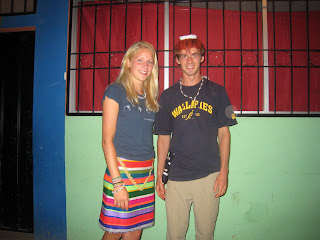
My media group, Google Earth, was reasonably finished with our project, so we headed over to the local night scene: "Kundu Night Market".  Our first task was to find appropriate attire -- the cheapest, ugliest Chinese apparel possible.  Dave and Zach bought matching t-shirts, trucker hats, and sunglasses.  Isabel bought earrings, and I got some ugly referee shirt as a last resort: all the ugly sequined shirts were surprisingly expensive.  

Then we hit the dancefloor.  The entire neighborhood was full of clubs, about half
 of them were just bars, but we managed to find some discos where locals packed onto the dancefloor.  We enjoyed terrible Chinese / euro pop music; mostly, it was just ridiculous, rhythmless, raging, and appropriate- no one much danced in pairs so much as in a circle.  


At one point, the music stopped for a show by a man wearing a ghoul's mask -- I think it was an attempt at a scary interlude at midnight.  After the eerie music died down, he proceeded to do a rendition of the ever-popular Thriller (MJ at his best) followed by the Chinese version of "If You're Happy and You Know it, clap your hands".  I don't have much experience with American clubs, but I'd be shocked if that was in the usual repertoire.  

All in all -- a very successful night.  

Shaxi Farewell

Our time in Shaxi flew by, and before we knew it, we were at the farewell banquet, where local musicians and dancers performed for us.  It was a good chance to see the Bai culture and traditions; of course the village life was noticeably different from urban lifestyles in Kunming, but otherwise it was subtle to distinguish between Han traditions and ethnic minority traditions (for us).  

After the Bai dancing, they turned to our group, and asked for an American performance.  At a complete loss of traditional American culture that we could share on the spot, we settled on the Macarena, followed by a painful rendition of "I'll Make a Man Out of You" from Mulan.  


Afterwards, I unexpectedly spent the whole evening with my host family.  Other nights, since we spoke no common language, my parents (both maybe late forties, and quite worn) had left me to go to bed by 6:30.  On our last night, though, they pulled me into the communal family living space, where we watched TV and exchanged photos.  They also called their nineteen year old daughter, who's away for high school, since the village has no higher ed, to speak to me in English.  She conveyed that her parents were unsure of how to communicate with me, but urged me to return to Shaxi.  

I've acquired quite the collection of local attire from each of my homestay families.  In Bua, of course, there was the traditional Tsa Chila skirt. In Kunming, I picked up the scarf (see above) that looks terribly like a boa.  My most recent acquisitions include the red Chinese trucker hat, which Dave has enthusiastically commandeered, and traditional Chinese flats.  By the end of the trip, I should be able to put together quite the collective outfit!


Wednesday, November 19

Shaxi

Shaxi town center

We arrived in Shaxi the other day, a village outside of Dali, Yunnan made up primarily of the Bai minority group. It was larger than I expected, though, with 4,000 families, and it's not as remote as I imagined. People still have cell phones, televisions, and electricity. It's beautifully preserved traditional architecture, which gives the town a very authentic feel. My homestay is in a traditional courtyard-style home, which is currently under construction. It looks like they're sticking with the traditional building style and methods, though it'll be interesting to see whether they choose to "modernize" their techniques at all.
The Bai language is only oral, and not written, so Han Chinese is taught in the schools. We'll be teaching at the village's one middle school, where 1,000 students go. Of these, about 75% continue on to high school or vocational school, though they must go elsewhere to a town that has these facilities. About 90 students each year enroll at college. We observed 7th and 8th grade English classes yesterday, and we'll be teaching the same ones today. The teachers, however, asked us not to teach our own agendas, as in Kunming, but want us to teach the lesson plan from the textbook.

Monday, November 17

leaving Kunming

Last night was our farewell banquet with all of our host families, with dinner, speeches, and pictures. It's hard to believe our three weeks in Kunming are already over. We've all been busy working on our media projects and we'll continue to do that over the next couple of days, so they'll be ready to upload by the time we leave China.
This morning we're headed to Shaxi, a small village also in Yunnan Province of an ethnic minority group called the Bai people. It's about ten hours away by bus, and we'll live there for the rest of our time in China.

the group at a Buddhist temple

Thursday, November 13

A Weekend of Coersion ...

The weekend was ours to do what we wanted. Friday evening started off tamely enough, when a couple of us saw the new James Bond 007 movie. Cinemas in China are quite different from in the US -- there were no young people under the age of mid-to-late thirties, and the woman next to me spoke on her cell phone the whole time.   The movie was decent, though, and I don't think it's come out in the States yet.  In fact, you can already buy the bootleg DVD here on the street for about seventy-five cents, even though it hasn't hit theaters back home yet.

Saturday, Renee, Lily, Isabel & I decided to use our independent student travel priveleges to explore outside of Kunming. We had hopes of reaching a region known for it's beautiful nature and tiny temples, and someone from our NGO gave us a piece of paper with the characters for our destination written on it. We learned just how difficult it is to navigate in a country where not only the spoken language, but the written characters, are completely foreign. After going to multiple different bus and train stations, we finally found a salesperson who was able to sell us tickets to Li Yiang, our destination. Well, sort of...

We thought we were going 120 kilometers outside of the city, but after only an hour or so, we were woken up by the driver and told quite clearly in charades to get off of the bus. Dazed from our naps, we looked around and saw that we were quite literally simply pulled over on the side of a multi-lane highway. No, we explained, we're going to Li Yiang. This is clearly not right. But they insisted this was Li Yiang, and we were forced off the bus.  (I should say we never felt in danger, and I think it's quite common for these buses to make stops on the way .... other passengers also were dropped off at various exits)

What we found once we'd walked miles off of the exit ramp was a small industrial town with few redeeming tourist attractions. We made do, however, and managed to find a cute restaurant for lunch. This far outside of the city, no one spoke even minimal English, and the woman who owned the shop called us back into the kitchen to choose what we wanted by pointing at ingredients.

Back in Kunming later that afternoon, the four of us were walking through Greenlake Park, one of the city's central locations, and a bustling place on a beautiful autumn afternoon. As we passed by a group huddled around a street performer, the woman singing in the center spotted us foreigners, pushed through the crowd, and literally dragged us in. She thrust a microphone in our hands, began playing a traditional Chinese instrument called an erhu, and insisted that we sing every English-language song she knew, from Jingle Bells to Eidelweiss. Unfortunately, none of the TBB singers were in the group. The four of us combined had severely limited musical skills, and despite our protesting, we were coerced into singing song after song for the crowd.

Me & Isabel


On Sunday, my mother woke me up bright and early, and led me out of the house. I wasn't sure where we were headed, but we picked up Zach and his host-mother on the way, and proceeded to go to the local ballroom dancing club. No, really. Some people go to church on Sunday mornings, apparently my family here goes ballroom dancing. This center was reminiscent of a seventies roller-rink, a giant floor with dark lighting, flashing disco balls, and loud music -- waltz, pop, and techno. I was paired with a fifty-year-old Chinese man with quite the mustache, who was not quite tall enough to spin me, but proceeded to drag me round and round for a number of hours. I should mention that my dancing skills are about on par with my singing ability. Nonetheless, our mothers got great amusement of watching us struggle, and the experience was pretty comical. Unfortunately, since I had no idea what was in store for us that day, I didn't have my camera. But use your wildest imagination -- and that's probably the reality of our experience.

Afterwards, we went to lunch, where we were brought some fruity alcohol drink, which we explained we could not drink. Our mothers scoffed and insisted we could. When we did not, my mother reached into her handbag and pulled out two candies. Zach and I ate what seemed at first to be an innocent chocolate truffle- until we bit in and discovered a liquoer filling: our mothers hooted in laughter -- see, you can have alcohol!

All in all, it was a good and amusing weekend, but one we had little control over. We were coerced off the bus, into a singing performance, onto the dancefloor, and into consuming spiked candies.

Wednesday, November 12

More on Education

The past two weeks in China have flown by. We've been busy with Chinese lessons (which, to be honest, haven't progressed beyond the most basic words), TBB seminars, and teaching English. As a group, we've been reading Pedagogy of the Oppressed by Paulo Freire, a Brazilian educator who wrote on the philosophy of education in the 1960s. The book essentially breaks the world down into the oppressed, and the oppressors, and uses the idea of being "more fully human" to criticize the "banking-method" of education (rote memorization, didactic teaching, and indoctrination) and espouse liberating education (a process of dialogue in which teachers are not authoritatively forcing knowledge upon students). It has provoked some interesting conversations and fits well with what we've been observing about the Chinese educational system.

We've had a number of lectures from local professors about China's education policies, about minoritys' education in rural areas, about the examination system. Yesterday we had a panel of three generations -- a 90-year-old man, a woman who grew up during the Cultural Revolution, and a high school student in the midst of the university entrance examination process himself. It was interesting to hear about their experiences anecdotally. It doesn't seem as though the educational system and overall attitudes towards it have changed much, with the exception of the period between 1966 and 1976 when Mao essentially halted education. And why should the attitudes have changed -- they date back thousands of years to Confucius and general reverence for the value of education. Yet China faces criticism from a number of education experts internationally, with their system based on a passive role for students, rote memorization, and grueling competition between students.

I've certainly seen some instances of this in the classrooms I've observed. In one, outside of Kunming, students were unable to answer some of the most simple questions orally -- "how old are you?" and yet their textbooks had fairly advanced essays and the written exercises were correctly answered. In this case, students were well trained to comprehend written English (and perform well on exams), but could not carry on a basic conversation.

In my school, the students are so practiced at answering certain questions that they cannot understand similar ones. When I asked "what school do you go to?" looking for a simple answer with the name of their school, they all answered, "I go to school by bike." "I go to school by bus."

Each day I began class by asking, "how are you?" I quickly learned that the students understand this phrase, and without fail, each time, they chorus in unison, "I am fine, thank you, and you?" After a couple of classes, I decided to teach the students other responses to the question -- add some variety -- and so we generated a list of other adjectives.

Because we saw each section only three times, for forty-five minutes each, we didn't cover much by way of complicated concepts. The schools had asked us to share American culture, so we talked about our families, teenage life, school, music, holidays. I don't have any delusions that I taught the students much , but I hope that they got to practice their spoken English, and perhaps found incentive to learn English -- a difficult subject that probably becomes frustrating in a class of memorization and testing. It was hard to reach all of the students in the class -- of sixty-five, maybe eight or ten volunteered to speak each class.

All in all, though, it was a fun experience. The students loved to see pictures of my family -- they all thought Stephen, who just turned sixteen, was in his twenties. They all gasped when they saw postcards of Boston, and a couple of boys recognized it for the Celtics.

Today the school had a huge sports celebration. There were no classes, and the entire school (four or five thousand) gathered at a stadium. The opening ceremony consisted of each class (three grades - twenty four classes in each grade) marching into the stadium and around the track, dressed in matching uniforms, for a good hour and a half. The ceremony was full of balloons, flags, music, banners with slogans like "nothing is impossible," "never say never," and "besides win, what else can we do?" Despite being mind-numbing after a few minutes, the ceremony was so interesting because I can't imagine American middle schoolers having the patience or discipline to march in unison like that, and I can't imagine the schools devoting the time and money to orchestrating it. In a way, it was a microcosm for the very system of education here in China -- a collective spirit, a seriousness, impressive grandeur. The sports will continue for the rest of the week so we're done teaching at that school.

Wednesday, November 5

Kunming

We've been in Kunming for a week now, and started teaching. I'm teaching twelve-year olds at Yun Da Fu Zhong, the city's most prestigious middle school. It's absolutely huge, with more than six thousand students, and has noticeably different resources from the public schools I've seen here. The facilities are new, the classrooms technologically advanced, and the teachers speak far better English than at other schools. I teach four different sections of seventh graders; each class has sixty five students. I'll only see each section three times each, so we don't actually have much time for substantive lessons. Mostly we're doing introductory presentations on American culture and giving them the chance to practice conversational English.
with middle school students

The educational system in China is somewhat different from the one back home. Historically, Confucian ideals have instilled the importance of education, and because of the one-child policy, parents push their only child to excel in school -- thus school is hugely important. The kids we've seen go to school sometimes six days a week, often until nine o'clock at night! The ultimate goal of middle and high school is to pass the matriculation exam for university (SAT, anyone?) But this test is far more grueling than anything in the US -- often up to forty-eight hours, the tests assess rote memorization. The raw score alone, and nothing else, determines your admittance to university. Only 21% of the students who take the entrance examinations find spots in a university.

a typical classroom

Things in China continue to be interesting and exciting ... Last Friday, we celebrated Halloween by watching a Chinese ghost film (perhaps the least frightening scary movie I've ever seen). This past weekend, we did some exploration of Kunming, learning the bus system, visiting temples and parks. On Sunday, my family taught me how to make dumplings. One night this week, I went with my mother to a dance class for middle-aged women: complete with traditional music and fans. I've learned the difficulty of going for a run during rush hour here - it's next to impossible with all the cars, buses, bikes, and pedestrians.

Each Thursday at the local park, there's an informal but well-attended gathering called English Corner, where all the students, businessmen, and ex-pats who want to speak English meet there in the evening to chat. Last week a couple of TBB-ers went, and I had the most interesting conversations about what I'm doing in China, about US politics, and about Taiwan. Everyone was extremely inquisitive and curious and friendly, eager to practice speaking.

The TBB group read Three Cups of Tea, written by David Oliver Relin about Greg Mortenson's work building schools in Pakistan. It related to a lot of our work, in development volunteer work, and in education. We met at a cafe to discuss the book, and we all pretty much agreed that though the story was amazing, the writing could hardly have been worse.

We'll keep teaching for a couple of weeks, having guest lectures, and TBB seminars. After that we'll visit a rural area also in Yunnan Provence, before heading off to Cambodia ... !


making dumplings .. hao chi

OBAMA WINS


We're all watching the election results live from here in Kunming, China. Just saw McCain's concession and Obama's acceptance speeches. We're all wearing our Obama t-shirts that Becca's mother sent for her birthday -- we've been walking around the city like a giant propaganda group for the past couple weeks while our other clothes were in the wash. Since it's been such a blogger-generation campaign I thought I'd make my contribution ...


GO OBAMA!

Saturday, November 1

Arrival in China

After five flights, nearly forty-eight hours of travel, and a hectic connection at LAX, our group has finally made it to our second core country, China. This month in Kunming we'll be focusing on educational systems. Kunming is the capital city of Yunnan provence in the south of China, bordering Vietnam, Cambodia, and Laos. Though it's a fairly large city, with a population of four million, it's not well known internationally or even necessarily within China. I actually stayed in Kunming last summer when I came to China with a program called Where There Be Dragons.

We're working in collaboration with our host-NGO, the Kunming Center for Cultural Learning & Development. They're helping to coordinate us with three local middle schools where we'll be teaching English. The TBB group is divided between a public school, a private school, and a half public / half private school in either pairs or singles. I'll be teaching solo at the half-and-half school, and classes will begin on Monday. In the meantime, we've been observing at the schools to see what the Chinese educational system is like and how English classes are generally taught.

We're living individually with homestay families -- pretty much everyone lives within a twenty minute walk of the TBB communal classroom, and all of our families are middle-class and live in high rise apartments. I'm living on a university campus where I think my host-parents are professors; most of what I think about my host family is based on inference, since no one speaks English, and my Mandarin is limited to "thank you". At meal times, my host mother calls in reinforcements - the English-speaking nephew.

The TBB group is also taking Mandarin lessons each morning, in small classes of five people. It's certainly a difficult language to get a foot in the door, what with the 2,000 + characters, the tonal differentiation, and the seemingly unphoenetic Pinyin anglecized words.

It's great to be back in China. I've seen places in Kunming that I recognize from my last trip, but I'm also living in a different neighborhood and seeing plenty of new things. With our Chinese classes, our TBB lectures, and teaching English, we'll have plenty to do and I suspect our time here will fly by.

Saturday, October 25

The Inca Trail & Machu Picchu

This past week, our group ventured to Peru to hike the Inca Trail.  We flew into Cusco, where we had a day to explore the winding cobbled streets and the marketplaces.  On Tuesday, we took a bus to our trailhead and began our four-day, three-night trek.

We hiked 6-16 kilometers each day, of varying altitude changes, and hiked 40 in total.  The trail was beautiful.  In places, it was dry and desert-like; in others, we saw snow-topped mountains.  Each night we camped in tents under the gorgeous southern hemisphere sky, and at altitude, the weather was freezing after sunset.  Local Quechua porters helped to carry all of our gear -- tents, sleeping bags, food for the duration of the trek. 

Wednesday was our most difficult day of hiking, culminating in a high-altitude pass called Dead Woman's Pass.  We all made it, however, and made it to camp to relax for the rest of the day.  

By Friday, we made it to Machu Picchu, the capital city of the Inca empire.  The site itself was something of a tourist attraction, swarming even by eight o'clock in the morning, so the most exciting parts were the mountain passes and the early morning sunrises that came on the Inca trail itself.  After taking a tour of the site, four of us hiked up Wayna Picchu (the singular peak famous in many post card pictures) where we had the best view yet of Machu Picchu.  

The group at the trailhead of the Inca Trail


Afternoon sunset from our campsite

Hiking along the way


The group at Machu Picchu (Wayna Picchu in the background)


View of Machu Picchu from atop Wayna Picchu

Sunday, October 19

Quito


We´ve spent the last four days in Ecuador´s capital city, Quito. We´ve had time to ourselves to go to the local market and stock up on traditional woolen wear, to go to internet cafes, and reaquaint ourselves with other types of food: Mexican, Indian, and Italian.

We went as a group to Quito´s largest water treatment plant to see, in contrast to Bua´s situation, water purification in an urban area. It was quite interesting to take a tour and speak with some of the employees, and it was surprisingly clean. It was on a hill, and had a great view onto the city. It meets international standards and is one of the most efficient treatment plants in the Americas.

We´ve also been working hard on media projects (text, video, podcast, and google earth), trying to finish them so we can publish them before we leave Ecuador.

My media group (text) working on our article at the hostel


Yesterday, the group, minus the sick people, went on a day hike of Rucu Pinchincha, a mountain just outisde of Quito. We started early, when the day was still crisp and clear, and took a gondola up part way. From there, we hiked four hours up to the top of 14,000 feet. The elevation was definitely touch, but hopefully it will help us acclimate before we start hiking Maccu Pichu next week. At the bottom, we had a great view of the sprawl of Quito, but by the summit, we were completely engulfed in clouds -- and it was quite cold!


Today we have an overnight flight to Peru. After a day in Cuzco, we´ll begin our five day trek to Maccu Pichu, an ancient Incan town.

Friday, October 17

Leaving Bua

The Aguavils

On Wednesday, October 15th, the group left Bua for Quito. We packed up our bags and said sad goodbyes to our families -- my host mother cried when the truck picked us up. They send their regards to all of my family and friends back home, and they hope that someday we will return. It´d be really interesting to see Bua in a couple of years or decades, since it´s already changed so much in only a couple of generations.


Noah and I on our log perch outside of our casita

... we spent many an afternoon passing time in this way

Thursday, October 16

Farewell Celebration in Bua

Noah & I with our host family
Rafael, Andy, & Diana

On Tuesday, our final night in Bua, the community had a despedida, or farewell celebration, for the TBB group of volunteers. My host-mother was happy to prepare me for the party -- I wore my new traditional Tsa Chila skirt that my family gave me: the vibrant, brightly colored striped skirt, and she also gave me a make-over. John got the male Tsa Chila treatment: the traditional achiote hairstyle, which involves crushing bright red berries into hair gel, and putting a crown of cotton balls on top.


John and I, in traditional Tsa Chila dress

We had one last traditional dinner of fish cooked in leaves and the infamous "log" (boiled unripe plantains, smashed and rolled into a flavorless, dense log) and then the festivities began ... Community leaders thanked us for our work, we thanked our host families, and each volunteer recieved a small gift of a beaded bracelet. We saw traditional Tsa Chila music, complete with a marimba and maracas, and a group from the cultural preservation center danced for us. After the ceremony, it was our turn to dance ... It was a great night for the outdoor celebration; we were under a full moon.


The cultural dance & music group


Traditional Tsa Chila dance

Wednesday, October 15

Guayaquil

Last weekend, some of the group traveled to Guayaquil on Indepedent Student Travel, meaning we made all of our own arrangements for transportation, lodging, and food, and we traveled without leaders. Eight of us went -- Alexandra, Alexis, Renee, Lily, Emily, John, Ian, and me -- on Friday and we returned to Bua on Sunday.

Guayaquil is on the coast in the south, and historically is a much more liberal and diverse city than Quito, because it was exposed to foreign merchants via sea trade. We noticed a number of signs and graffiti opposing the constitution, because it also tends to be more economically conservative. Much like the United States, Ecuador´s political affiliations seem to be very regional.

We stayed at a really interesting hostel with lots of open-air spaces, hammocks, parrots, and free (delicious) breakfast: french toast. It wasn´t in a central location, however, so we took a public bus to the center on Saturday morning. We walked along the Malecon, the boardwalk that follows the river. We wandered into an older part of town, Las Penas, where we got lunch and discovered freshly churned ice cream. We visited the MAAC, the museum of Anthropology and Contemporary Art, where the exhibits varied from old pottery remains to progressive political artwork. One of the biggest surprises there was seeing a real Salvador Dali watercolor -- I noticed it, and thought that someone was ripping off his warped clock motif, but when I looked closely, it turned out to be a genuine piece!


the group on the Malecon


Saturday evening we got dinner on the boardwalk where there was live music and far more people than we´d seen all day. We were in Guayaquil just days after the city´s independence celebration, and we´d expected it to be crowded and lively. All day, it seemed deserted, but at night, people did come out to celebrate. The boardwalk was full of people, and we spent the evening just wandering and taking in the sights: tons of vendors selling food, people with wild hats, and fireworks.

It was a great weekend trip, and we made it back to Bua in time to watch Ecuador beat Chile in qualifying rounds for the 2010 World Cup!

Saturday, October 11

Water Issues in Bua

In each of our core countries we focus on a different aspect of development; in Ecuador, our focus is clean water. We´ve seen a number of water issues in Bua, and most of them seem to revolve around the river. About twenty or thirty years ago, the river water was potable and large fish lived in it -- a large part of the local diet. Now, the water is not remotely drinkable, the water level has shrunk, and only tiny minnows live there. Firstly, pollution has contaminated the water -- both from litter (there is no trash disposal in Bua, since wrappers from consumer products are a relatively new thing there), and from agricultural pesticides. Run-off from erosion has led to stagnation and weeds growing. People use the river for just about everything: bathing with non-biodegradeable soap, gutting fish, washing clothes, using bleach. Lastly, human waste disposal is contributing to the problem: currently, the sanitation system is either to simply use the woods as a bathroom, use an outhouse, or to use toilets that lead to overflowing septic systems. The run-off from all of this is making its way into the river, making the water contaminated and allowing algae to thrive.

This all raises a number of issues. One day our group went on a river clean-up walk, picking up the trash we saw, but because there is no disposal system, the bags of litter we collected will probably ultimately end up right back in the river. If the river is going to be cleaned up, there needs to be a garbage system, and everyone has to agree not to litter. Similarly, with agricultural pesticides, which the Tsa Chila say come from Mestizos (mixed ethnicity Ecuadorians) without education about how to use them, the lucrative economic benefit of seems to outweigh the long-term environmental impact.  The government pays $100 for each hectacre of preserved forest, but that same amount of land can bring in $4,000 from yucca cultivation, which leads to deforestation and erosion and chemical pesticide contamination.  

We're in the middle of working on our media projects which address this clean water issue -- there are four groups, and each works with a different form of media: text, podcast, video, or Google Earth.  I'm in the text group, and within a couple of days our final pieces should be up.

Saturday, October 4

Constitution Passes!

If you´re interested -- http://cnn.mlogic.mobi/cnn/ne/world/detail/175115/full;jsessionid=1FBBCF8C5A672952CF40A77407FBB3E7

The Constitution passed by a pretty large margin, about 60 - 30, roughly.

books: The End of Poverty and The White Man´s Burden

The End of Poverty by Jeffrey Sachs
The White Man´s Burden by William Easterly

A big part of our curriculum in Ecuador has been learning about general international aid and international development -- reading about the United Nations, the World Bank, the IMF, etc. For reading, we split the group into two, and each group read chapters from either The End of Poverty by Jeffrey Sachs or The White Man´s Burden by William Easterly -- many people ended up reading both. Both authors are esteemed economists who have worked directly in large international organizations, the World Bank and the UN, but each has come up with drastically different perspectives about how to address poverty in the future.

Sachs, who played a large role in creating the UN´s Millennium Development Goals, calls upon developed nations to collaborate with developing nations, giving increased percentages of GDP towards extreme poverty alleviation -- a comprehensive, collaborative international effort to eliminate extreme poverty (under $1.25 a day -- one sixth of the world population) by 2025. Easterly, who wrote his book as a direct response and critique of Sachs´, calls for the opposite, essentially grassroots initiatives to assess each community in need individually, rather than money coming from the top, where it may get lost in corrupt governments.

We simulated a debate between the two, and we ended up tackling the assumptions of each author. I enjoyed reading the two, and the contrast offered really interesting perspectives about big questions.

Weekend Trip to Sua


This weekend the group is taking a weekend trip to the coast - to the touristy beach town of Sua (not to be confused with Bua). Friday afternoon we caught a five hour bus ... Lily´s camera was stolen, making that the third theft. Two other cameras have broken, as well. I´m just biding my time until mine die, too.

We´re staying in a hostel right on the beach. It´s a tiny little town full of cabana bars and little hostels, a pretty tourist spot at its prime, but it must be the off-season. We pretty much have the weekend to ourselves; we´ve been wandering and walking on the beach. So far a little too overcast to swim, but I wouldn´t rule that out for the whole weekend. It´s been nice to have a shower, rather than bathing in a twelve-inch river where people clean fish, bleach clothing, and dispose of pesticides -- the river in Bua is really a pollution issue. Had yogurt for breakfast, rather than tuna and raw onions. It´s a nice change of pace and scenery from Bua, for a couple of days.

October 4th marks one month into the trip! It seems as though it´s gone really quickly so far. One more month til the election! Some people have already received their absentee ballots in the mail; I´ll get mine in China. I´m anxious for all the campaigning to be over and finally know the result (fingers crossed.) We´ll be in China at the time.