Saturday, October 25

The Inca Trail & Machu Picchu

This past week, our group ventured to Peru to hike the Inca Trail.  We flew into Cusco, where we had a day to explore the winding cobbled streets and the marketplaces.  On Tuesday, we took a bus to our trailhead and began our four-day, three-night trek.

We hiked 6-16 kilometers each day, of varying altitude changes, and hiked 40 in total.  The trail was beautiful.  In places, it was dry and desert-like; in others, we saw snow-topped mountains.  Each night we camped in tents under the gorgeous southern hemisphere sky, and at altitude, the weather was freezing after sunset.  Local Quechua porters helped to carry all of our gear -- tents, sleeping bags, food for the duration of the trek. 

Wednesday was our most difficult day of hiking, culminating in a high-altitude pass called Dead Woman's Pass.  We all made it, however, and made it to camp to relax for the rest of the day.  

By Friday, we made it to Machu Picchu, the capital city of the Inca empire.  The site itself was something of a tourist attraction, swarming even by eight o'clock in the morning, so the most exciting parts were the mountain passes and the early morning sunrises that came on the Inca trail itself.  After taking a tour of the site, four of us hiked up Wayna Picchu (the singular peak famous in many post card pictures) where we had the best view yet of Machu Picchu.  

The group at the trailhead of the Inca Trail


Afternoon sunset from our campsite

Hiking along the way


The group at Machu Picchu (Wayna Picchu in the background)


View of Machu Picchu from atop Wayna Picchu

Sunday, October 19

Quito


We´ve spent the last four days in Ecuador´s capital city, Quito. We´ve had time to ourselves to go to the local market and stock up on traditional woolen wear, to go to internet cafes, and reaquaint ourselves with other types of food: Mexican, Indian, and Italian.

We went as a group to Quito´s largest water treatment plant to see, in contrast to Bua´s situation, water purification in an urban area. It was quite interesting to take a tour and speak with some of the employees, and it was surprisingly clean. It was on a hill, and had a great view onto the city. It meets international standards and is one of the most efficient treatment plants in the Americas.

We´ve also been working hard on media projects (text, video, podcast, and google earth), trying to finish them so we can publish them before we leave Ecuador.

My media group (text) working on our article at the hostel


Yesterday, the group, minus the sick people, went on a day hike of Rucu Pinchincha, a mountain just outisde of Quito. We started early, when the day was still crisp and clear, and took a gondola up part way. From there, we hiked four hours up to the top of 14,000 feet. The elevation was definitely touch, but hopefully it will help us acclimate before we start hiking Maccu Pichu next week. At the bottom, we had a great view of the sprawl of Quito, but by the summit, we were completely engulfed in clouds -- and it was quite cold!


Today we have an overnight flight to Peru. After a day in Cuzco, we´ll begin our five day trek to Maccu Pichu, an ancient Incan town.

Friday, October 17

Leaving Bua

The Aguavils

On Wednesday, October 15th, the group left Bua for Quito. We packed up our bags and said sad goodbyes to our families -- my host mother cried when the truck picked us up. They send their regards to all of my family and friends back home, and they hope that someday we will return. It´d be really interesting to see Bua in a couple of years or decades, since it´s already changed so much in only a couple of generations.


Noah and I on our log perch outside of our casita

... we spent many an afternoon passing time in this way

Thursday, October 16

Farewell Celebration in Bua

Noah & I with our host family
Rafael, Andy, & Diana

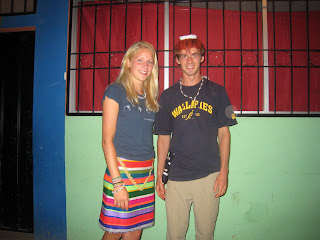
On Tuesday, our final night in Bua, the community had a despedida, or farewell celebration, for the TBB group of volunteers. My host-mother was happy to prepare me for the party -- I wore my new traditional Tsa Chila skirt that my family gave me: the vibrant, brightly colored striped skirt, and she also gave me a make-over. John got the male Tsa Chila treatment: the traditional achiote hairstyle, which involves crushing bright red berries into hair gel, and putting a crown of cotton balls on top.


John and I, in traditional Tsa Chila dress

We had one last traditional dinner of fish cooked in leaves and the infamous "log" (boiled unripe plantains, smashed and rolled into a flavorless, dense log) and then the festivities began ... Community leaders thanked us for our work, we thanked our host families, and each volunteer recieved a small gift of a beaded bracelet. We saw traditional Tsa Chila music, complete with a marimba and maracas, and a group from the cultural preservation center danced for us. After the ceremony, it was our turn to dance ... It was a great night for the outdoor celebration; we were under a full moon.


The cultural dance & music group


Traditional Tsa Chila dance

Wednesday, October 15

Guayaquil

Last weekend, some of the group traveled to Guayaquil on Indepedent Student Travel, meaning we made all of our own arrangements for transportation, lodging, and food, and we traveled without leaders. Eight of us went -- Alexandra, Alexis, Renee, Lily, Emily, John, Ian, and me -- on Friday and we returned to Bua on Sunday.

Guayaquil is on the coast in the south, and historically is a much more liberal and diverse city than Quito, because it was exposed to foreign merchants via sea trade. We noticed a number of signs and graffiti opposing the constitution, because it also tends to be more economically conservative. Much like the United States, Ecuador´s political affiliations seem to be very regional.

We stayed at a really interesting hostel with lots of open-air spaces, hammocks, parrots, and free (delicious) breakfast: french toast. It wasn´t in a central location, however, so we took a public bus to the center on Saturday morning. We walked along the Malecon, the boardwalk that follows the river. We wandered into an older part of town, Las Penas, where we got lunch and discovered freshly churned ice cream. We visited the MAAC, the museum of Anthropology and Contemporary Art, where the exhibits varied from old pottery remains to progressive political artwork. One of the biggest surprises there was seeing a real Salvador Dali watercolor -- I noticed it, and thought that someone was ripping off his warped clock motif, but when I looked closely, it turned out to be a genuine piece!


the group on the Malecon


Saturday evening we got dinner on the boardwalk where there was live music and far more people than we´d seen all day. We were in Guayaquil just days after the city´s independence celebration, and we´d expected it to be crowded and lively. All day, it seemed deserted, but at night, people did come out to celebrate. The boardwalk was full of people, and we spent the evening just wandering and taking in the sights: tons of vendors selling food, people with wild hats, and fireworks.

It was a great weekend trip, and we made it back to Bua in time to watch Ecuador beat Chile in qualifying rounds for the 2010 World Cup!

Saturday, October 11

Water Issues in Bua

In each of our core countries we focus on a different aspect of development; in Ecuador, our focus is clean water. We´ve seen a number of water issues in Bua, and most of them seem to revolve around the river. About twenty or thirty years ago, the river water was potable and large fish lived in it -- a large part of the local diet. Now, the water is not remotely drinkable, the water level has shrunk, and only tiny minnows live there. Firstly, pollution has contaminated the water -- both from litter (there is no trash disposal in Bua, since wrappers from consumer products are a relatively new thing there), and from agricultural pesticides. Run-off from erosion has led to stagnation and weeds growing. People use the river for just about everything: bathing with non-biodegradeable soap, gutting fish, washing clothes, using bleach. Lastly, human waste disposal is contributing to the problem: currently, the sanitation system is either to simply use the woods as a bathroom, use an outhouse, or to use toilets that lead to overflowing septic systems. The run-off from all of this is making its way into the river, making the water contaminated and allowing algae to thrive.

This all raises a number of issues. One day our group went on a river clean-up walk, picking up the trash we saw, but because there is no disposal system, the bags of litter we collected will probably ultimately end up right back in the river. If the river is going to be cleaned up, there needs to be a garbage system, and everyone has to agree not to litter. Similarly, with agricultural pesticides, which the Tsa Chila say come from Mestizos (mixed ethnicity Ecuadorians) without education about how to use them, the lucrative economic benefit of seems to outweigh the long-term environmental impact.  The government pays $100 for each hectacre of preserved forest, but that same amount of land can bring in $4,000 from yucca cultivation, which leads to deforestation and erosion and chemical pesticide contamination.  

We're in the middle of working on our media projects which address this clean water issue -- there are four groups, and each works with a different form of media: text, podcast, video, or Google Earth.  I'm in the text group, and within a couple of days our final pieces should be up.

Saturday, October 4

Constitution Passes!

If you´re interested -- http://cnn.mlogic.mobi/cnn/ne/world/detail/175115/full;jsessionid=1FBBCF8C5A672952CF40A77407FBB3E7

The Constitution passed by a pretty large margin, about 60 - 30, roughly.

books: The End of Poverty and The White Man´s Burden

The End of Poverty by Jeffrey Sachs
The White Man´s Burden by William Easterly

A big part of our curriculum in Ecuador has been learning about general international aid and international development -- reading about the United Nations, the World Bank, the IMF, etc. For reading, we split the group into two, and each group read chapters from either The End of Poverty by Jeffrey Sachs or The White Man´s Burden by William Easterly -- many people ended up reading both. Both authors are esteemed economists who have worked directly in large international organizations, the World Bank and the UN, but each has come up with drastically different perspectives about how to address poverty in the future.

Sachs, who played a large role in creating the UN´s Millennium Development Goals, calls upon developed nations to collaborate with developing nations, giving increased percentages of GDP towards extreme poverty alleviation -- a comprehensive, collaborative international effort to eliminate extreme poverty (under $1.25 a day -- one sixth of the world population) by 2025. Easterly, who wrote his book as a direct response and critique of Sachs´, calls for the opposite, essentially grassroots initiatives to assess each community in need individually, rather than money coming from the top, where it may get lost in corrupt governments.

We simulated a debate between the two, and we ended up tackling the assumptions of each author. I enjoyed reading the two, and the contrast offered really interesting perspectives about big questions.

Weekend Trip to Sua


This weekend the group is taking a weekend trip to the coast - to the touristy beach town of Sua (not to be confused with Bua). Friday afternoon we caught a five hour bus ... Lily´s camera was stolen, making that the third theft. Two other cameras have broken, as well. I´m just biding my time until mine die, too.

We´re staying in a hostel right on the beach. It´s a tiny little town full of cabana bars and little hostels, a pretty tourist spot at its prime, but it must be the off-season. We pretty much have the weekend to ourselves; we´ve been wandering and walking on the beach. So far a little too overcast to swim, but I wouldn´t rule that out for the whole weekend. It´s been nice to have a shower, rather than bathing in a twelve-inch river where people clean fish, bleach clothing, and dispose of pesticides -- the river in Bua is really a pollution issue. Had yogurt for breakfast, rather than tuna and raw onions. It´s a nice change of pace and scenery from Bua, for a couple of days.

October 4th marks one month into the trip! It seems as though it´s gone really quickly so far. One more month til the election! Some people have already received their absentee ballots in the mail; I´ll get mine in China. I´m anxious for all the campaigning to be over and finally know the result (fingers crossed.) We´ll be in China at the time.

book: Confessions of an Economic Hit Man


Confessions of an Economic Hit Man by John Perkins

We all read this book over the course of Costa Rica and the beginning of Ecuador. It´s all about the ¨corporatocracy¨of international development aid in which the US economists predict hugely exaggerated forecasts of economic growth in developing nations, justifying their credit so that the World Bank will grant them a loan to invest in infastructure or natural resources, with the condition that the construction projects be leased to huge US companies. Of course, when a nation cannot repay the debt, they are at the mercy of the World Bank and the corporations. Many countries must devote more than half of their GDP to repaying interest alone, not even making progress on the initial sum.

I wasn´t necessarily so shocked by the fact that there are greedy CEOs out there who want to make enormous profits. What was more surprising was that all of this selfish capitalism was happening under the farce of international äid¨to improve the living conditions of those in extreme poverty. It was pretty disillusioning about the role of the World Bank and the IMF and the multi national investing companies.

What´s more, the book offered a pretty interesting psychological aspect as to why Perkins, the author, continued in his profession for decades. He understood what was happening, and considered quitting for years, but didn´t. The excuses he offers time and time again are frustrating and raise questions about what really drives people.

I would recommend this -- it´s a quick and easy read, and introduced me to a world of corruption that I hadn´t realized existed.

Saturday, September 27

Photos from Bua


Our homestay house -- on the right, the family house -- built by a government grant about a year ago, with one central room, two small bedrooms, and an add-on wooden kitchen in the back built by the family. On the left, the guest ¨casita¨, or little house, that Noah and I share, that they built earlier this summer to house relatives for Andy´s baptism.


The construction site at the school -- in the foreground, the bases for the six eco toilets (with two chambers each so that one can lay fallow half the time). The hired skilled workers did most of this concrete brick laying -- the TBB group mostly worked to dig the trenches in the background, haul dirt, and do other various projects around the school like redoing sinks.

Me with my host-brother, Andy (on the right) and a neighborhood kid.


Some kids at the elementary school where we´ve been working on toilet building.


Evening sunset over a game of volleyball at the local tienda.

Friday, September 26

New Constitution Rally


We had an exciting trip the other day. On Monday morning (22nd), the group all reported to the school, ready to keep digging trenches for the project. Someone mentioned that they had watched the morning news with their family and learned that Rafael Correa, Ecuador´s president, would be speaking that day in Santo Domingo, the nearest city to Bua. His administration has been promoting the new constitution, which is being voted on this Sunday (28th). We jokingly agreed that we should all go to the rally, and Sandy and Robin agreed, so we actually all hopped in the back of a cattle truck and headed for Santo Domingo.


The rally was in a giant open-air pavillion, and since we got there a couple of hours early, we had legit seats within the first fifteen rows or so. Eventually the entire place was completely full, mostly with older interest groups or field trips from local high schools. Some local government officials spoke and awarded micro-financing checks to certain individuals, and then Correa came out. The crowd loved him. He gave a very compelling speech about the unique aspects of the constitution, which, if approved by citizens, would replace the previous one from 1998.


The constitution seems to be pretty liberal -- calling for health care for all, education, allowing abortion, preserving culture, favoring local business rather than foreign investment, protecting oil reserves. I have learned from my host family that it is an obligation for all citizens to vote -- they have to recieve a slip of paper confirming that they voted in order to pay taxes and avoid a fine. In fact, this whole weekend, Friday through Sunday, is a nation-wide dry weekend: alcohol cannot be served so that everyone is in fit shape to vote! It seems that there is a lot of support for the constitution, and my host father predicts that it will pass.


At one point in the middle of his speech, Correa saw the large group of foreigners in the crowd, directed his attention to TBB, and said, in English, welcome, and that now was a time of change and revolution. We had woken up that morning expecting to manhandle piles of dirt, and instead we were quite literally personally addressed by the president of Ecuador... no big deal.


Afterwards, we were approached by many curious people. One of them is a lawyer for the district government here in Santo Domingo, and she was interested in our volunteer work in Bua, so she came out later in the week to see the project -- raising awareness, and perhaps funds, for YanaPuma and for the school.


Saturday, September 20

Bua, Ecuador

We´ve been at Bua for a couple days now. We arrived on Tuesday and settled in with our homestay families: Noah and I are staying with Rafael (27), his wife Diana (23), and their son Andres (7). They are members of the TsaChila nationality, a group of Ecuadorians who live in seven remaining communities. The TsaChila all speak Spanish in addition to their native langauge, Tsa Fiki.

We live, conveniently, right across from the elementary school where we work everyday. At the school, we are working with Yanapuma and a group of volunteers from Engineers without Borders to construct six ecotoilets. The school´s current sanitary system was designed to accomodate 75 students when it was built ten years ago, but now, because the school´s principle has worked so hard to attract students from neighboring villages, the school has more than 250 students. The nearest city, Santo Domingo, doesn´t have the capacity to clean out septic tanks, so once they´re full, they´re simply abandoned. Thus the school has serious issues with contamination and overflow.

Ideally, the toilets will be able to accomodate the school´s increased population and will be eco-friendly: in addition to safetly containing waste, it will ultimately produce a useable and nutrient-rich soil. So far we´ve helped to dig trenches and lay pipes. Hired skilled workers are the ones who do most of the concrete laying, and so far the engineers have had to modify their original design. We have been able to observe some of the difficulties in implementing development in a rural community like Bua: firstly, communication. There are several different groups of volunteers here, Thinking Beyond Borders, Engineers without Borders , funneled here through Yanapuma, and these different groups have to work in conjunction with the community, the school itself, and the skilled workers. Secondly, we´ve seen how designs created in the USA cannot necessarily be implemented in other places: the engineers made sure to ask if Ecuadorian cement blocks had holes in them, but they didn´t realize that the holes don´t go all the way through, so we can´t thread riebar through them. Thirdly, the community itself sometimes doesn´t understand the intent of those volunteering. When Yanapuma intially came to the village, they learned that no map of the community existed, and when they tried to make one, the community reared back because they thought the information would be fed to the government to make them pay taxes.

Back at our homestays, we often bathe in the river, help to do dishes, play marbles with Andres ... I´ve learned some really interesting bits about the TsaChila culture through speaking with my host mother. She came from one of the other seven TsaChila communities and seems to miss her own family a lot. She explained to me that the TsaChilas ären´t allowed to marry white people¨ -- I actually got to look through a TsaChila ¨rule book¨ type pamplet in the living room, and it had rules like you must marry within the nationality, what types of roles women should play (cook, clean, and raise children), and the customary clothing (for men, black and white striped skirts, for women, very brightly striped skirts). The men also have a tradition of dying their hair red with berries that grow here.

It´s really exciting to be in Ecuador at this time. In a week or so, the country will vote on whether or not to implement a new constitution. Their constitution changes pretty regularly, I think about twenty times in the past couple decades. My homestay family was shocked that our USA constitution ´hasn´t been changed in more than two hundred years! Correas, the current president, is proposing a fairly liberal constitution that would allow abortion, is vague on gay marriage, and, some hope, would equalize socioeconomic conditions.

Something else that struck me about being in Ecuador is that they use as thier national currency the US dollar. They dollarized about eight years ago due to hyperinflation and have used the dollar ever since.

We certainly don´t have internet in the village, so right now the group is on a day trip to Santo Domingo, a hyper-industrial, kind of grimy little city about forty minutes from Bua by cattle truck. Tomorrow is Sunday so we won´t be working but spending the day with our homestay families.

Monday, September 15

Ecuador

Yesterday we flew into Quito -- apparently the most difficult airport to land at because of the runways and the altitude.  We're at almost 10,000 feet above sea level, nearly two miles.  

Today we met with our in-country host organization, called Yanapuma.  It's an NGO based in Quito that has been around for about 2 years and does various projects around the country promoting sustainable development and cultural preservation.  Tomorrow we'll be beginning our month-long homestay in a TsaChila village called Bua, about forty minutes outside of a town called Santo Domingo.  We'll be living with families there, building eco toilets at the elementary school.  

Saturday, September 13


The group after hiking down to a waterfall.

Introductory Post & Orientation in Costa Rica


Hello everyone!


I should have posted an introductory post before I left, but between packing and that strenuous life-guarding job, I never got the chance, so let me say a little bit about the program.


I graduated from Winsor in June, and I’ll be going to Columbia in the fall of 2009, and in the mean time, I’m taking a gap year with a program called Thinking Beyond Borders. I actually never planned to take a year off, but in April, my college counselor mentioned that there would be a gap year fair at Nobles, and so I decided to stop by one weekend. While I was there, I discovered and fell in love with TBB.


www.thinkingbeyondborders.org


This is the first year that they’re running the program, but it seems to be incredibly well run so far. There are sixteen students and three leaders: Sandy & Robin (who are married) and Nina. We’ll be spending the next eight months together, traveling the world and studying global development issues.


The basic structure of the program focuses on five main countries, and in each one we focus on a different issue: Ecuador (clean water), China (public education), Vietnam (the environment), India (sustainable agriculture), and South Africa (public health). In each main country, we do an individual homestay and work directly with a local NGO (non-governmental organization) that specializes in our focus. In between each of the main countries, we have an enrichment week, essentially a vacation week to decompress and process and come back together as a group, so those trips will include hiking Machu Pichu in Peru, going to Angkor Wat, scuba-diving in Thailand, seeing the Taj Mahal in India, and going to a National Park in South Africa. After all that, we come and spend six more weeks together in the United States, drawing connections between everything we’ve seen. We’ll be meeting with the United Nations, the World Health Organization, the International Monetary Fund, and small NGOs in New York City and Washington DC.


I’ll explain more about the program as I go, but that’s good for now.


The trip began on September 4th, when the group met in Houston and flew to San Jose, Costa Rica, for a ten-day orientation. We spent the time in a small costal town called Playa Uvita, which is on the Pacific, south side of the country. We lived at a small co-op owned hostel type place, on an unpaved road with few local shops. We were a half hour walk from the beach, so many of the mornings some of us would wake up early to catch the high tide and surf, which I’ve never done before, but began to get the hang of.


Early morning surfing -- catching the high tide at 5:00 AM (Zach & Noah)

We spent the week having group discussions (rules, safety, curriculum) and doing outdoor activities. Highlights included kayaking in a mangrove grove, hiking to a waterfall, taking a boat trip to an island, going on a nighttime beach hunt to help preserve turtle eggs from poachers, and seeing a local soccer tournament.


We discussed our summer reading – Ishmael, by Daniel Quinn, and The End of Poverty by Jeffrey Sachs. The group opinions differed about each book, but I would recommend them both. Ishmael, or its sequel My Ishmael, is a quick read with a heavy message about the nature of human society. The End of Poverty is a very well written, easily accessible book written by an economist who pioneered the United Nation’s Millennium Development Goals.


We’re back in San Jose now for the night before our flight to Quito, Ecuador. From there, we’ll drive about four hours to our site.


The group is great so far; everyone is really getting along and seems to be having a great time. I’m really excited to start our first main country and hopefully remember my Spanish!